Driving Care Forward — Sustainably
Every day, home care workers in the UK drive over 4 million miles. That’s more than 1.5 billion miles a year — and it adds up to around 400,000 tonnes of CO₂ emissions annually.
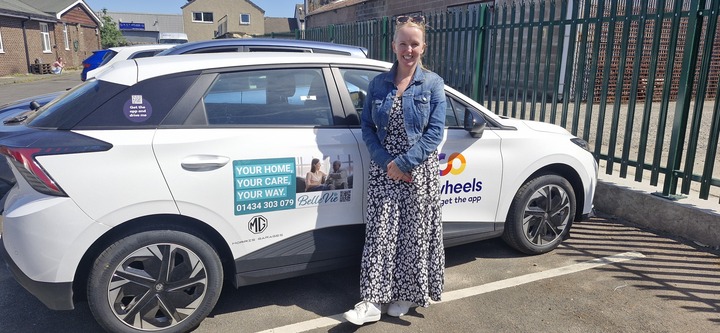
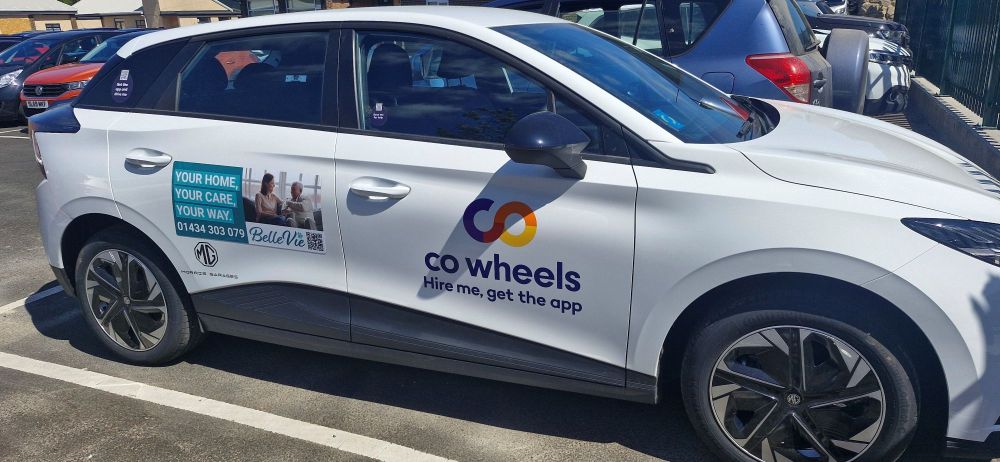
At BelleVie, we believe the essential work of caring for people at home shouldn’t come at such a high cost to the planet. That’s why, with the support of the Rayne Foundation, and working together with social enterprise Co Wheels, we’ve launched a pilot project in rural Northumberland, putting our first fully electric vehicle (EV) on the road.
Why This Matters
Social care has been slower to decarbonise than healthcare. More than half of social care providers still have no environmental strategy or emissions reduction plan, leaving a critical gap in action and investment. With demand for home care only increasing, now is the time to make greener choices.
Replacing an average petrol or diesel car with an EV can save around 2 tonnes of CO₂ a year. If widely adopted across the sector, the impact would be transformational.
Our Approach
BelleVie has been innovating in sustainable care travel for years.
We’ve trialled and rolled out cycle-based care teams in urban areas.
In 2024, we piloted AI-driven rota optimisation in our Wellbeing Operating System (OS) to reduce travel distances and emissions.
Now in 2025, we’re testing the feasibility of EV adoption in rural settings — where travel demands are higher.
.
This Northumberland pilot will help us understand the environmental, financial, and social impact of EVs in home care. We’ll be looking at:
Real-world charging patterns and availability
Driving behaviour and mileage
Running costs compared to petrol/diesel vehicles
Staff engagement and feedback
.
Looking ahead
The data from this project will be shared to help other home care providers, operators, and policy makers make informed choices about cleaner transport options.
Long-term, our goal is to support a social care sector that works for people, the planet, and the future — where caring for others goes hand-in-hand with caring for the environment.
.